
In LEGUMINOSE, farmers across Europe are testing how intercropping cereals and legumes can work in real-world conditions. The Union of Small Farmers (UPA) is coordinating living labs on several farms in Spain – combining hands-on experimentation with strong farmer involvement.
In this interview, David Erice from UPA shares lessons from the field, reflecting on what it takes to test new agricultural practices, the challenges of bringing intercropping into a complex farming and market system, and how farmers can help shape more sustainable grain production.

DE: “My name is David Erice and I work at the Technical Office of the Union of Small Farmers of Spain (UPA). UPA is an agricultural organization that represents and defends the interests of the Spanish family farmers – the largest group in the country.
In LEGUMINOSE, we have launched intercropping experiments on several farms across Spain to test the potential of growing cereals and legumes in the same field at the same time.”
Looking back…
DE: “Our work has gone through several stages. Initially, UPA staff, together with affiliated entities and farmer representatives from various regions, analysed where and how the project could be best implemented. We identified critical areas for field trials and carefully selected suitable locations for the LEGUMINOSE on-farm living labs. Throughout the field trials, the farmers involved have been in constant contact with UPA’s technical staff, both for defining agronomic requirements (such as sowing rates, fertilisation, harvesting methods) and for monitoring the crops and recording final yields. After the campaign ended, we prepared final reports and shared the results with participating farmers.
In addition to the field work, we have carried out various communication activities to broaden the project’s impact and results. For example, Over the last 14 months, we have organised six visits to some of the farms, articles in La Tierra magazine, and press releases to expand knowledge of the results obtained.”


…and ahead
DE: “We are currently in the second field trial campaign. Based on what we learned from the first campaign, we have made some adjustments and improvements. In addition to the shared living lab design used across all LEGUMINOSE countries, we introduced variations in Spain to test whether intercropping can reduce fertiliser use without needing to grow both crops to full maturity.
We look forward to completing this campaign and hope that the adverse weather conditions we are experiencing in Spain, particularly the hail that accompanies storms, does not severely affect our experiments. Once the data are in, we will analyse what new lessons can be drawn to support farmers.”
From challenges…
DE: “The biggest challenge has been implementing experiments that, from an agronomic perspective, and even more so from a commercial perspective, don’t make much sense in Spain. For example, marketing a mixed grain products of cereal and legume is currently not considered very attractive, as there are no marketing channels. Even separating the two crops after harvest can raise concerns among processors about possible contamination. On top of that, adverse weather conditions have posed a significant challenge throughout the field trials.”
…to proud moments
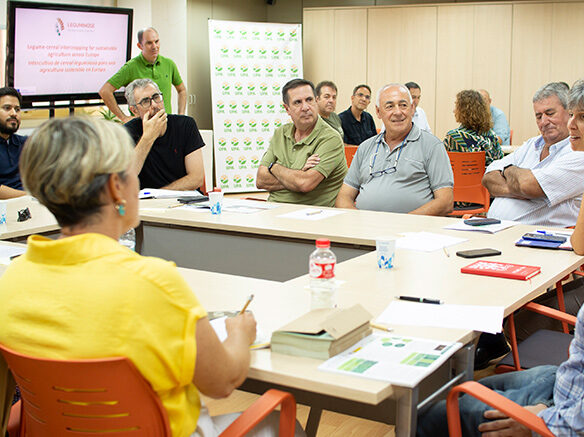
DE: “In the final part of the first field trial campaign, we had several conversations with participating farmers. These farmers were the first to identify improvement options regarding the potential use of intercropping and its relationship to more sustainable grain production. Some of these suggestions were implemented in the second field trial campaign, and we are confident that their involvement will lead to further collaborations in the future, even beyond the lifetime of the LEGUMINOSE project.”

The value of intercropping

DE: “Legumes are essential in field crop rotations. As we face increasing uncertainty due to climate change, rising input prices, and stricter regulations for food production, farmers need practical information about the benefits these crops can provide, and how innovative practices like intercropping can offset these uncertainties. While I do not believe intercropping is the definitive solution to all problems – and I don’t think it will become the norm in Spain, it certainly offers opportunities to improve cereal production in specific contexts.”
Bridging research and practice
DE: “For UPA, it is essential that farmers participate in these types of initiatives. It is important to take advantage of the resources that the European Union provides. But it is even more important that the ultimate beneficiaries of this knowledge – the farmers themselves – take part in developing and testing new knowledge. Agricultural production requires greater investment in research and innovation, and UPA is always willing to be part of networks that allow us to capitalize on the fruits of this investment.”
From adverse weather to limited market options, the Spanish trials show that adopting intercropping is not without its hurdles. But they also highlight the value of co-creation: when farmers are part of the process, research becomes more grounded, practical, and future-oriented. The experiences from UPA and its network of farmers offer important insights into what it takes to test and adapt sustainable practices in diverse farming contexts.